
Built for enterprise-grade private connectivity
ELCOME combines Starlink's LEO satellite coverage with in-country private network integration, monitoring, and dedicated support. The result is a secure extension of your corporate network to hard-to-reach locations.
Private network handoff
Aggregate Starlink traffic and hand it off directly to your network or cloud for secure, controlled connectivity.
Low-latency LEO backhaul
High-performance satellite connectivity designed for enterprise and government applications.
Operational visibility
Flexible data pooling, performance monitoring, and APIs for real-time insight.
24/7 support and field service
Global deployment assistance and ongoing support from the ELCOME NOC.
Choose the integration model that fits your team
Whether you speak in L2VPN and L3 or just need a secure way to extend your network, we provide a clear choice between a transparent Ethernet extension and a managed routed handoff.
Layer 2 Private Ethernet (EVPL / L2VPN)
A transparent Ethernet extension that lets your network team keep full control of routing, segmentation, and overlays.
Layer 3 Managed IP (eBGP)
A routed handoff where ELCOME provides the first hop and aggregates traffic for simple integration.
How the PNI service fits into your network
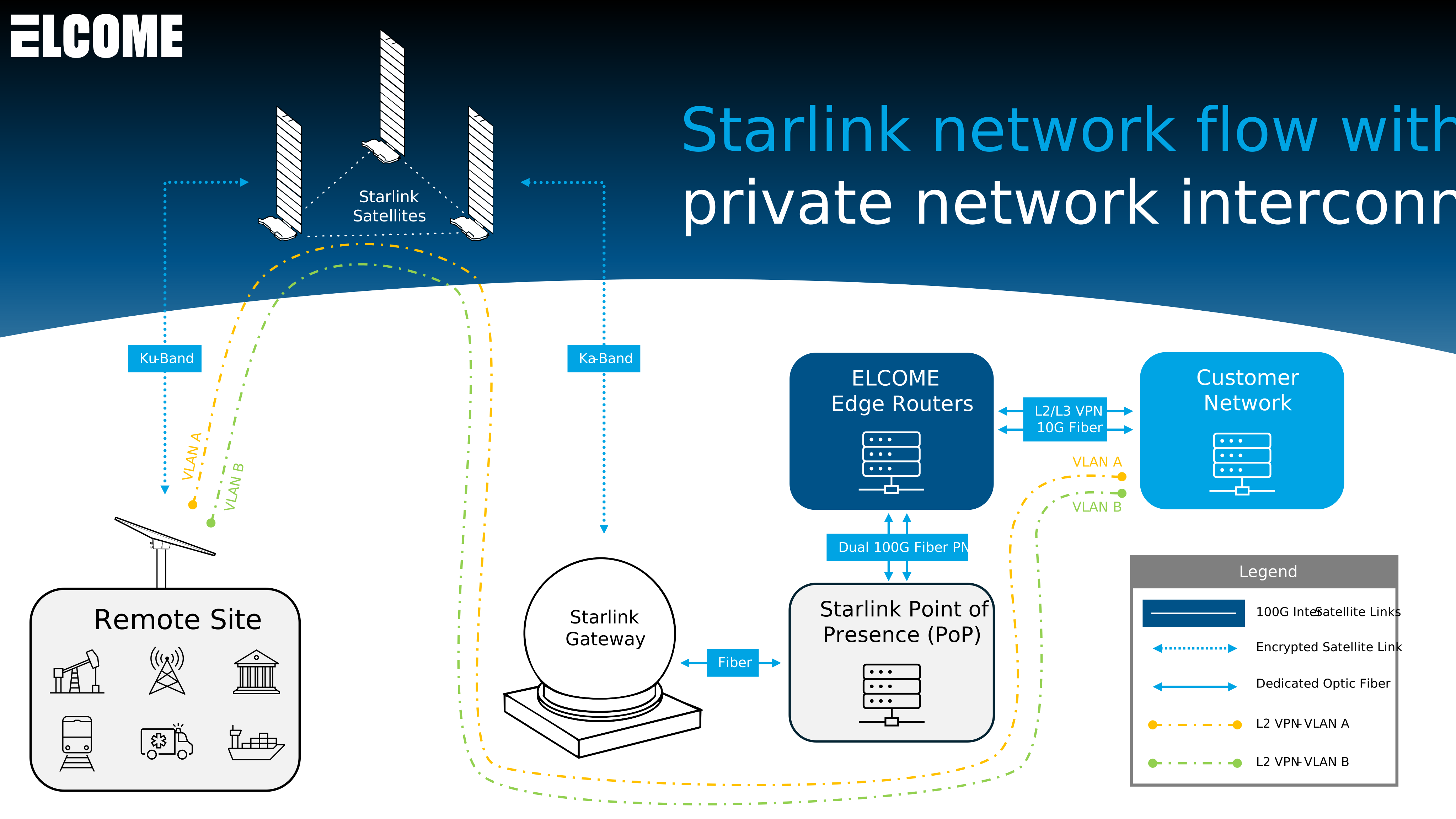
Starlink user terminals connect remote sites to the satellite network, while ELCOME provides the private handoff to your core network or cloud environment within the same country. Traffic stays private by default and your team retains end-to-end visibility.
- ✓Secure satellite backhaul with encrypted underlay
- ✓In-country private handoff to your network or cloud targets
- ✓Optional internet breakout when needed
- ✓Monitoring, reporting, and support from the ELCOME NOC
Availability and site eligibility
Starlink PNI is expanding quickly. We will confirm coverage during planning to ensure the right regional handoff for your sites.
Important usage notes
- ⚠Starlink PNI traffic cannot cross national borders. Both the Starlink terminal and the private network handoff point must be located within the same country. Multi-country deployments require a separate PNI instance in each country.
- ⚠PNI services are limited to fixed sites or coastal vessels only and are not appropriate for ocean-going vessels.
What you can build with Starlink PNI
Private network integration unlocks connectivity architectures that were previously impossible over satellite. Here are three of the most impactful deployment patterns.
PNI by industry
You don't need to know what MPLS or BGP means to benefit from a private network. If your organization needs a secure, dedicated connection between remote locations and your central systems, these examples show what Starlink PNI can do for your industry.
Secure field communications that don’t depend on cell towers
When a wildfire, hurricane, or flooding event takes out local cell towers and power, first responders lose the connectivity they rely on for coordination. With Starlink PNI, a fire command post, mobile hospital, or emergency operations center can establish a private network link back to dispatch and state systems in minutes — without depending on any local infrastructure.
Incident commanders get real-time access to CAD, mapping, and inter-agency systems over a private link that stays up when terrestrial networks go down.
PCI-compliant branch connectivity without leased lines
Banks, credit unions, and ATM operators expanding into underserved or rural markets often face a difficult choice: pay for expensive MPLS circuits or compromise on security with public-internet VPNs. Starlink PNI provides a private path from a branch or ATM location directly to the bank’s core data center or cloud, satisfying the same network isolation requirements as a dedicated leased line.
Financial institutions can open branches and deploy ATMs in locations where leased-line connectivity would cost tens of thousands per year — while maintaining the private-network posture that auditors and regulators expect.
Private SCADA and telemetry backhaul for distributed assets
Oil and gas producers, wind farm operators, and electric utilities manage thousands of remote assets — wellheads, substations, turbines, solar arrays — spread across regions with no fiber access. These sites generate critical operational-technology (OT) data that must stay isolated from the public internet. Starlink PNI gives each site a private Ethernet or routed connection back to the control center without building a terrestrial network.
Operations teams gain real-time visibility into distributed assets over a private path, reducing mean-time-to-detect for equipment faults and eliminating the security risk of routing SCADA traffic over the public internet.
Dedicated uplink bandwidth for remote production
Live events, news crews, and production teams increasingly operate in locations — stadiums, rural venues, disaster zones — where shared internet connections cannot guarantee the sustained upstream bandwidth that live video requires. With Starlink PNI, the production feed travels over a private, dedicated path from the venue to the broadcaster’s playout facility or cloud encoder, avoiding the congestion and unpredictability of the public internet.
Production teams get a private, low-latency uplink path they can count on for multi-camera live feeds, remote commentary, and real-time file transfers — deployable in hours at virtually any location.
Managed private connectivity for every location
Large retail and restaurant brands operate hundreds or thousands of locations, many in strip malls, rural towns, or newly developed areas where commercial broadband is unreliable or slow. Each location runs point-of-sale, inventory management, digital signage, and security cameras — all of which need a stable, secure connection to HQ. Starlink PNI lets the chain connect every store over a single private network, regardless of whether the location has good terrestrial broadband or not.
IT teams manage one consistent, private WAN across all sites instead of juggling dozens of regional ISPs — and new locations can be brought online in days rather than the weeks or months it takes to provision leased circuits.
HIPAA-ready connectivity for rural clinics and mobile units
Rural hospitals, tribal health clinics, and mobile medical units often lack the network infrastructure to securely transmit patient records, medical imaging, and real-time telehealth video. Public internet connections in these areas are typically slow and create compliance concerns around patient data. Starlink PNI provides a private network path from the clinic to the health system’s EHR platform and cloud, helping satisfy the same network-isolation expectations as a hospital’s on-campus LAN.
Clinicians in remote locations can access electronic health records, transmit imaging studies, and conduct live telehealth consultations over a private link — expanding care access without compromising patient data security.
Campus-grade networking for remote schools and field stations
Schools in rural and island communities, university field research stations, and domestic distance-education programs struggle with connectivity that is too slow for modern digital learning and data-intensive research. Starlink PNI connects these sites directly to a university’s core network or a school district’s data center within the same country, enabling the same applications — LMS platforms, video collaboration, cloud storage — that urban campuses take for granted.
Students and researchers at remote sites get access to the same network resources as their on-campus peers, and IT departments retain centralized control of security policy and content filtering.
Extend your corporate network to coastal vessels and port facilities
Port operators, coastal shipping companies, and offshore logistics firms need their tugs, barges, coastal warehouses, and nearshore vessels on the same private network as their shore-side operations — for ERP access, container tracking, and crew HR systems. Public internet from port Wi-Fi is unsecured, and traditional VSAT is too slow. Starlink PNI connects coastal vessels and port facilities to HQ over a private path at broadband speeds, as long as the vessel and the network handoff are in the same country.
Operations teams can run the same enterprise applications aboard a coastal vessel or at a remote port facility as they do at headquarters, with data staying on the corporate network from terminal to data center. For ocean-going international routes, standard Global Priority with encrypted overlay provides the best-fit solution.
Security, monitoring, and support
Starlink PNI uses an encrypted satellite underlay and can be paired with your own security overlays such as IPsec. ELCOME monitors the handoff and backhaul, while your team controls routing and policy.
We provide global field service, proactive monitoring, and a 24/7 NOC to keep mission-critical sites online and visible.
Pricing
Pricing is being finalized. Contact our team for early guidance and design support.